
- English
- Español
- Português
- русский
- Français
- 日本語
- Deutsch
- tiếng Việt
- Italiano
- Nederlands
- ภาษาไทย
- Polski
- 한국어
- Svenska
- magyar
- Malay
- বাংলা ভাষার
- Dansk
- Suomi
- हिन्दी
- Pilipino
- Türkçe
- Gaeilge
- العربية
- Indonesia
- Norsk
- تمل
- český
- ελληνικά
- український
- Javanese
- فارسی
- தமிழ்
- తెలుగు
- नेपाली
- Burmese
- български
- ລາວ
- Latine
- Қазақша
- Euskal
- Azərbaycan
- Slovenský jazyk
- Македонски
- Lietuvos
- Eesti Keel
- Română
- Slovenski
- मराठी
- Srpski језик

Agricultural Machinery Engines: What's the Difference Between Gasoline and Diesel?
How well a piece of agricultural machinery performs really comes down to its engine. On the market today, you’ll mainly find two types: gasoline engines and diesel engines. They differ in how they work, how they perform, what they cost to run, and even their environmental impact. Let’s take a closer look at these differences to help you choose the right power source for your equipment.
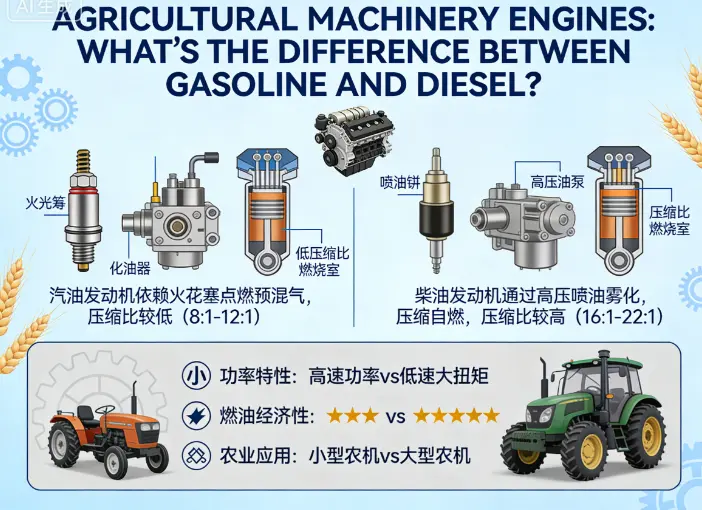
Different Ways of Working
The most fundamental difference lies in how they ignite the fuel. Gasoline engines use a spark plug—a tiny electric spark sets the fuel-air mix on fire. Diesel engines, on the other hand, rely on compression. The piston squeezes the air so tightly that it gets extremely hot, causing the fuel to ignite on its own. This core difference shapes everything else about how they perform.
Performance Comparison
Diesel engines have a higher compression ratio, which makes them more thermally efficient. For engines of the same size, a diesel typically packs more punch, especially at lower speeds. This translates to more pulling power for heavy tasks.
Gasoline engines are quick to start and respond faster, but they can lack the sustained grunt of a diesel when under heavy, continuous load.
Fuel Economy
It’s common knowledge that diesel fuel goes further. Doing the same job for a day, a diesel engine will usually use less fuel than a gasoline one. This advantage becomes even clearer during long, uninterrupted work sessions.
While a gasoline engine might take less fuel per fill-up, its higher fuel consumption rate often means higher long-term costs.
Durability
Diesel engines are known for their simpler, tougher build. They can handle harsh conditions—dust, sun, rain—and keep going. Many experienced farmers will tell you a well-maintained diesel can easily last a decade or more.
Gasoline engines are a bit more sensitive. They don’t like moisture or dust as much and generally require more attentive care.
Breaking Down the Costs
Beyond the fuel bill, you have to factor in maintenance and repairs. Diesel engines, with their simpler design, often have longer service intervals and cheaper parts. Gasoline engines usually need more frequent servicing, and some of their more precise components can be costlier to replace.
Over the engine's entire lifespan, the total cost of ownership for a diesel is often lower.
Environmental Impact
Emission standards are getting stricter, and both engine types have been improving. The black smoke once associated with older diesel engines is much less common in newer models. Gasoline engines have also made progress in reducing carbon monoxide emissions.
When choosing, check the machine’s emission rating—models meeting China's Stage III or Stage IV standards should comply with current regulations.
How to Choose the Right One?
The best choice depends entirely on your needs:
· For smaller machinery like walk-behind tractors or sprayers, a gasoline engine offers portability, easy starts, and flexibility.
· For larger equipment like tractors or combines that face long hours of heavy work, the diesel's advantages in power and endurance really stand out.
· Also consider local fuel availability. In some remote areas, diesel might be harder to find than gasoline.
In short, there's no single "best" option—only what's best for your specific situation. With advancing technology, we're also seeing more hybrid and new-energy agricultural machines, offering even more choices in the future.
The best advice is to try out different models, compare them carefully, and pick the one that best matches the jobs you need to get done.